Portfolio Prototype · Powered by Official Public Data
Opening Soon Radar
Hospitality Launch Signal Monitor
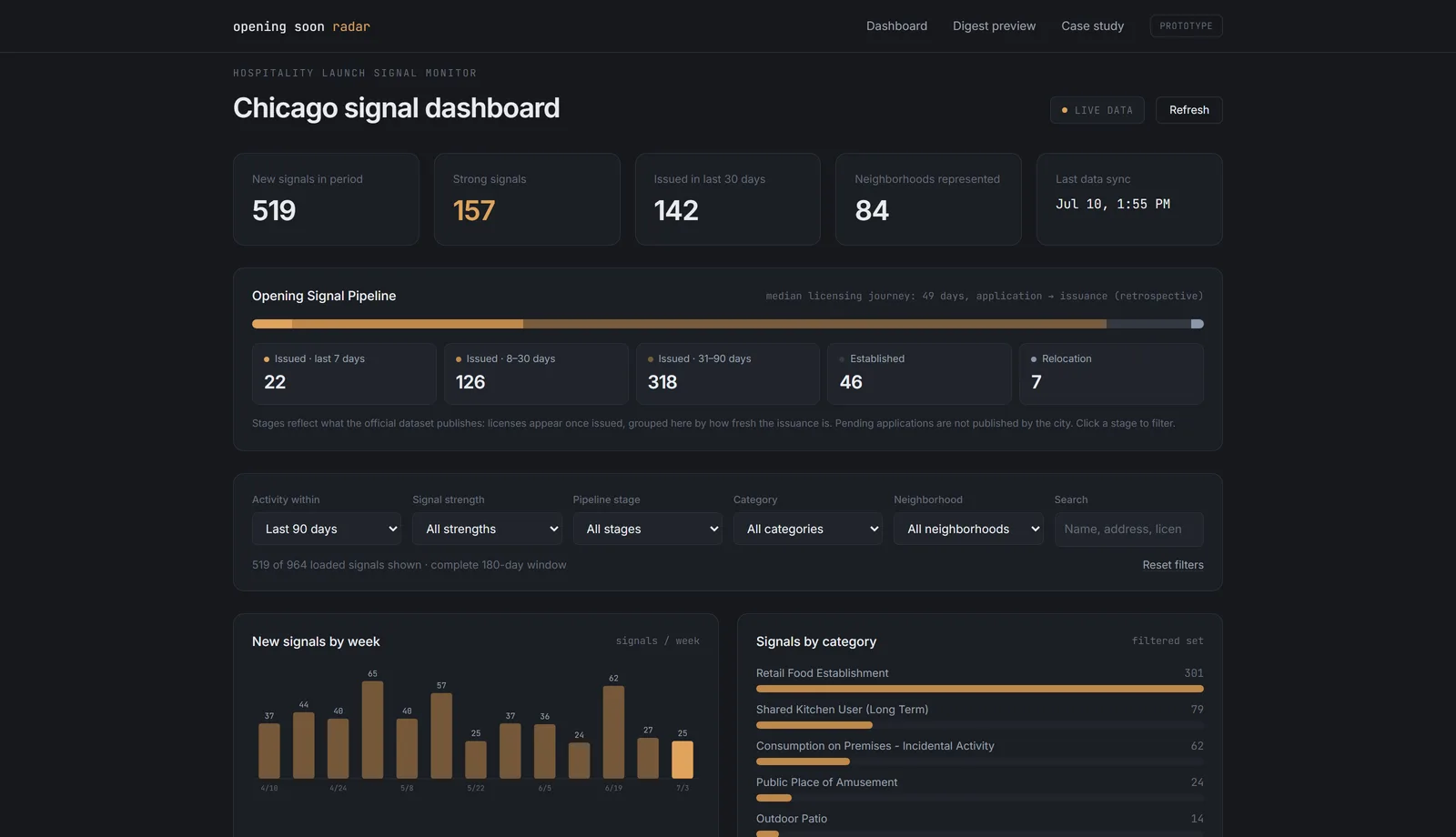
Opening Soon Radar watches official City of Chicago licensing activity, filters newly issued hospitality licenses and relocations out of the renewal noise, and turns those records into a focused vendor dashboard and weekly opportunity digest.
The problem
Vendors that sell to restaurants and bars often discover new businesses only after opening announcements, directory listings, or advertising appear. Official licensing records can reveal earlier commercial activity, but the records are noisy, full of renewals, and difficult to monitor consistently.
The approach
Watch → Filter → Deliver
01 · WATCH
Check the official City of Chicago business-license dataset daily for newly issued hospitality licenses and meaningful changes like relocations.
02 · FILTER
Remove renewals, irrelevant categories, duplicates, and incomplete entries, then rank the remaining signals with transparent, deterministic rules.
03 · DELIVER
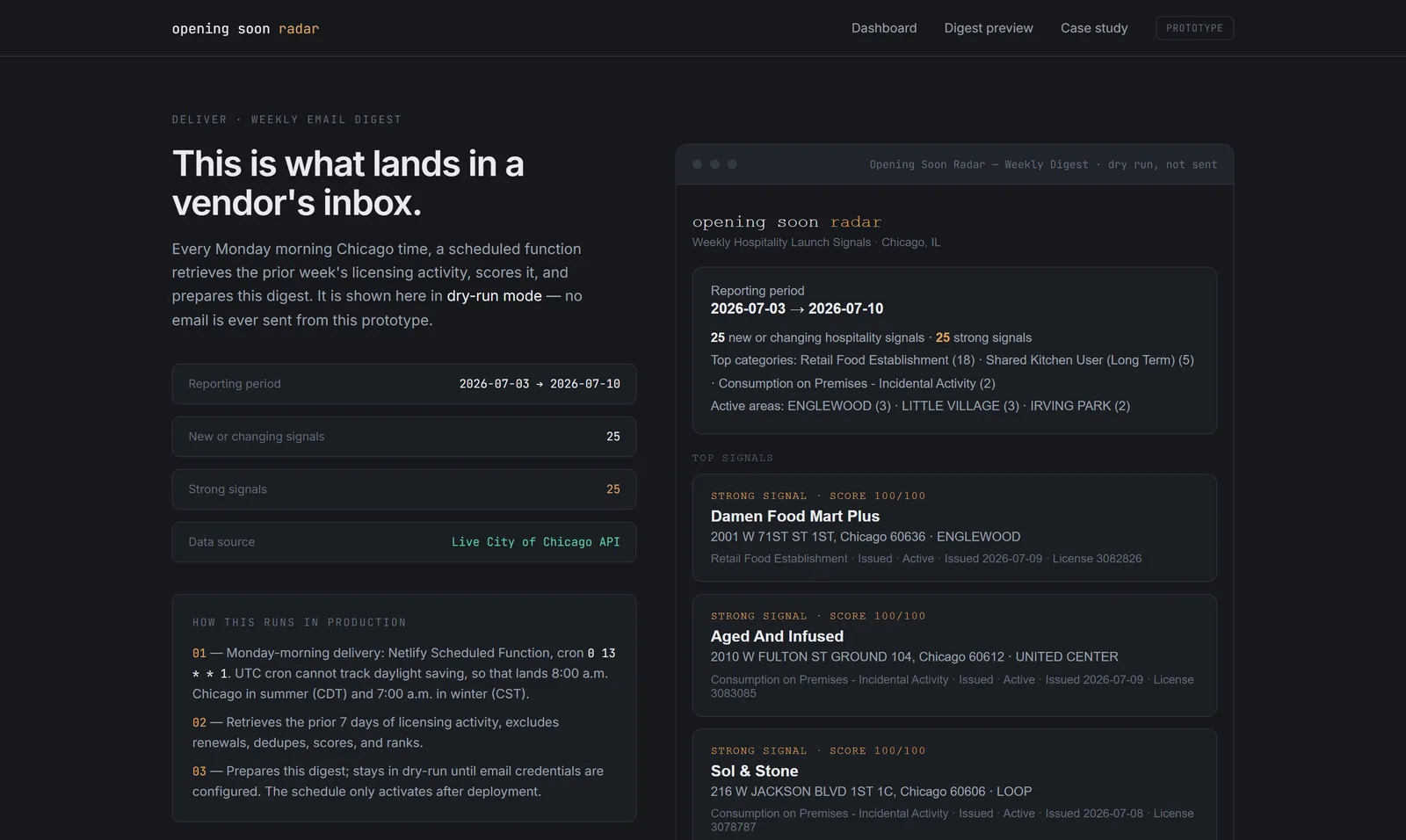
Present signals through a responsive dashboard and prepare a Monday-morning digest for local hospitality vendors.
The build
A second market, the same discipline.
Official public API. Socrata SODA queries with server-side field whitelisting — no scraping.
Renewal filtering. The dataset's application-type flag lets renewals be excluded at query level; only new licenses and relocations enter the app.
Netlify serverless function. All retrieval, normalization, deduplication, and scoring run server-side, with light caching to spare the city API.
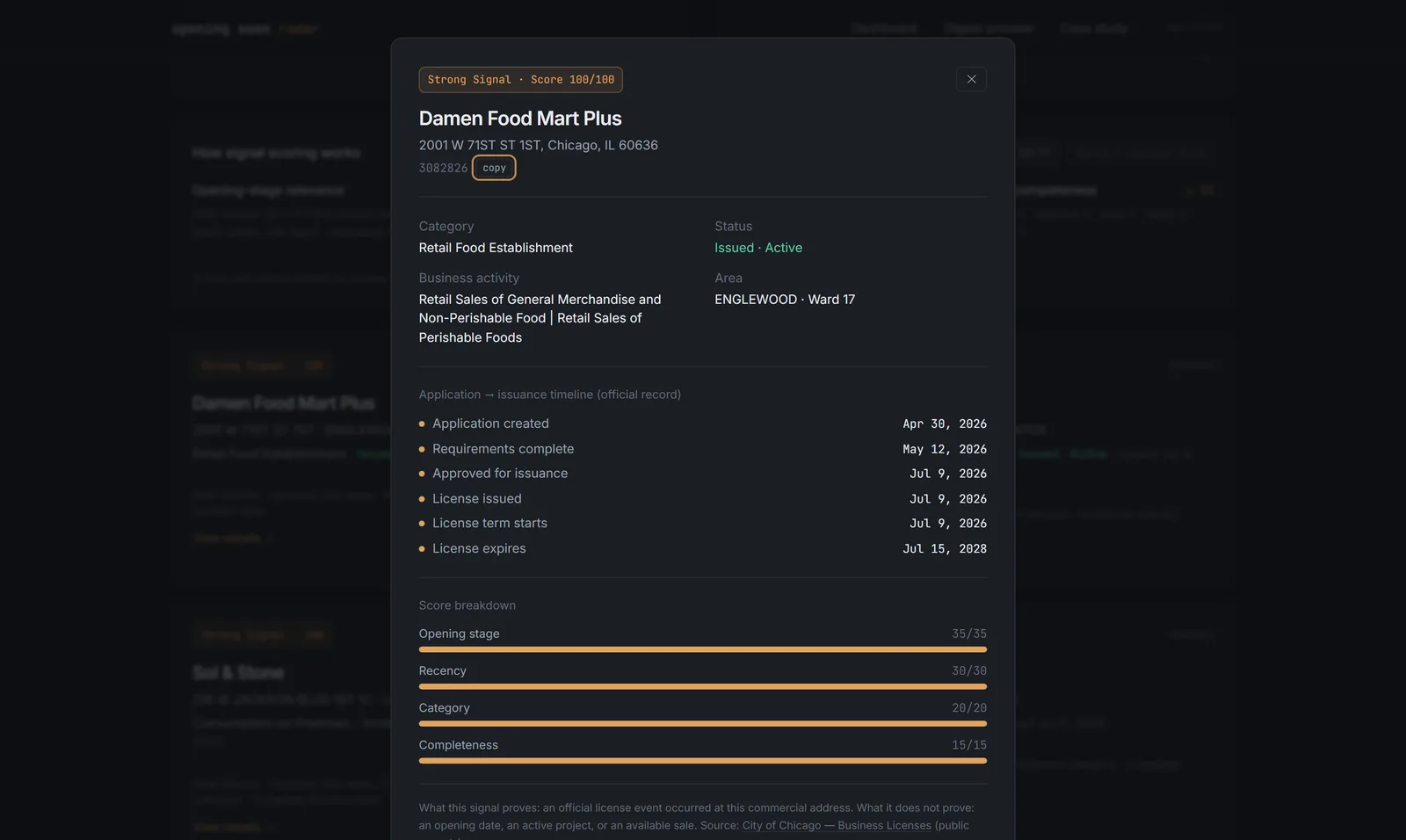
Deterministic signal scoring. A documented 0–100 model: opening stage, recency, category fit, completeness — thresholds recalibrated against live data. No AI where none is needed.
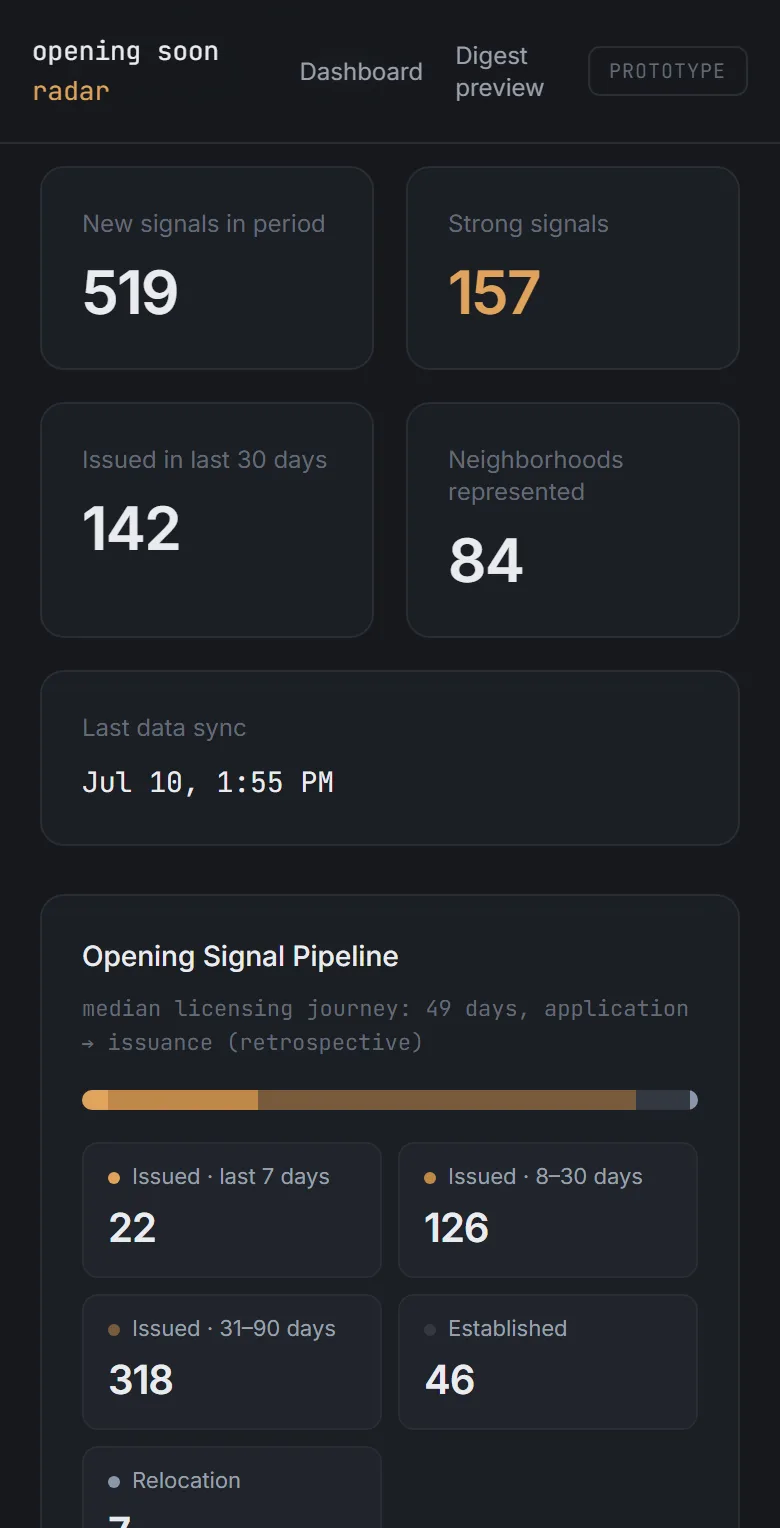
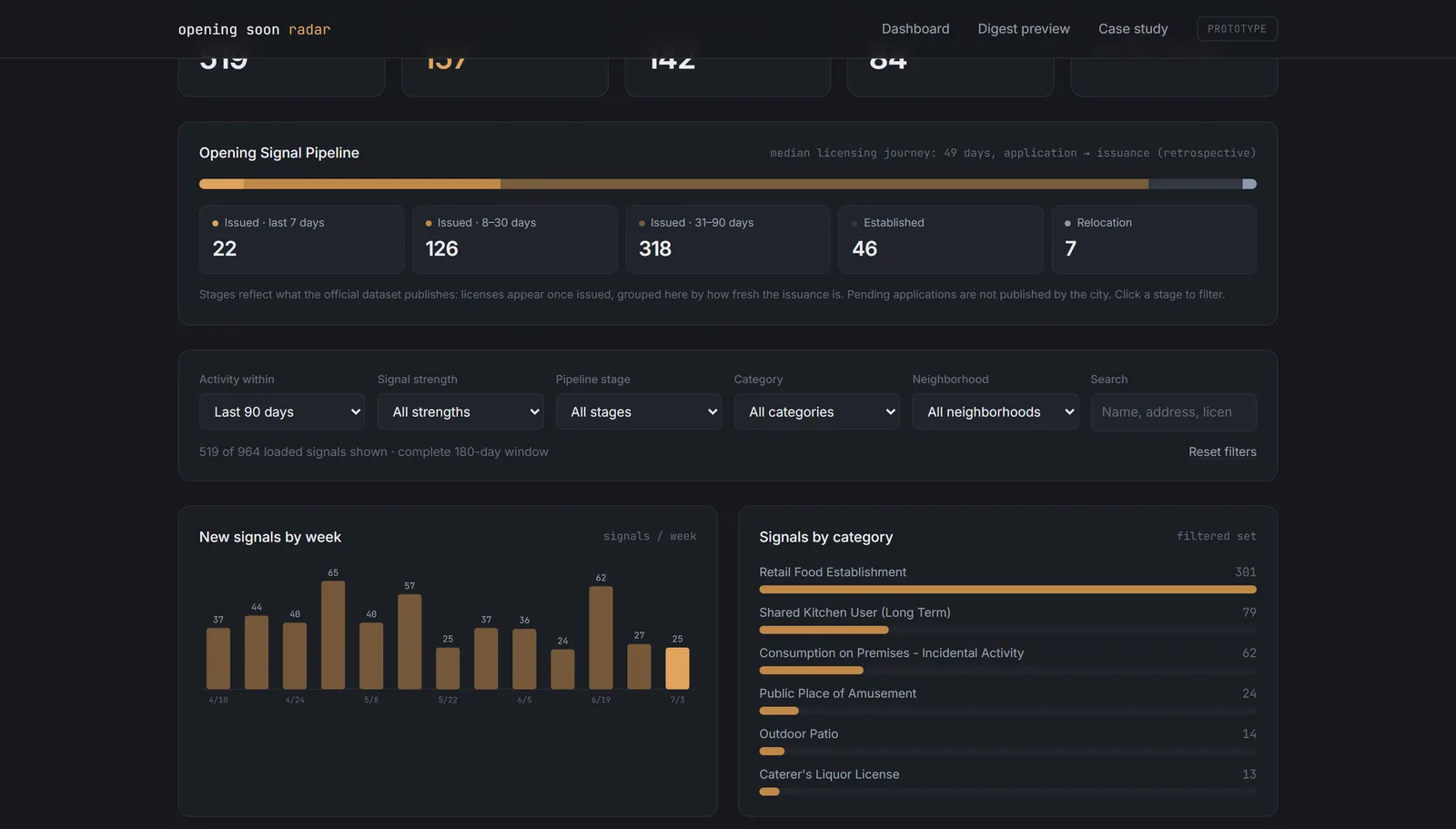
Opening Signal Pipeline. Records grouped into honest issuance-freshness stages, with the median filed-to-issued duration computed from real timelines.
Six dashboard filters. Date range, signal strength, pipeline stage, category, neighborhood, and free-text search.
Two visualizations. New signals by week and signals by category — hand-rolled SVG/CSS, no chart library.
Record detail dialog. Each license's full application → issuance timeline from the official record, plus a four-part score breakdown.
Weekly digest preview. An email-safe vendor digest rendered from the same data path as the dashboard; scheduled function stays in dry-run.
Live-data fallback. If the city API is unreachable, a cached sample of real records loads — clearly labeled.
Verified outcome metrics
What the finished build showed.
964
live records retrieved during verification (complete 180-day window)
519
signals in the default 90-day view
153
signals with activity in the latest 30 days
157
strong signals in that view
84
Chicago neighborhoods represented
49 days
median licensing journey, application → issuance (retrospective, default 90-day view)
Live
City of Chicago open-data API, updated daily
$0
data-acquisition cost for the prototype
Observed during build verification on July 10, 2026 against the live API. These figures are not permanent market statistics.
Technical architecture
Five stages, one direction.
01
City of Chicago Business Licenses (Socrata)
02
Netlify Function
03
Normalize / Filter Renewals / Deduplicate
04
Transparent Signal Scoring
05
Dashboard + Weekly Digest
Privacy and responsible design
- · Addresses shown are commercial premises from official public licensing records — never residential.
- · Personal-looking owner names are withheld; the establishment name is preferred. No contact enrichment is performed.
- · Scores rank records for review — they do not predict an opening, purchase, or conversion.
- · Licensing activity does not confirm an opening date, an available sales opportunity, or that purchasing decisions remain unmade.
Validation status
Opening Soon Radar is a working portfolio prototype. The open business question is whether licensing records are early and actionable enough for local hospitality vendors — equipment suppliers, POS vendors, sign companies, distributors, insurance brokers — to justify paying for recurring access.
It demonstrates: official government-data integration · scheduled monitoring architecture · server-side normalization · renewal and duplicate filtering · transparent signal scoring · responsive dashboard design · digest preparation · graceful fallback handling · responsible public-data presentation.
Watch → Filter → Deliver
What opportunities are hiding in information you already have access to?
I build focused tools that watch changing information, filter out the noise, and deliver the signals that matter.
Get in touch